

Is Assisted Living Tax Deductible? We Tackle Your Most Common FAQs
At Coastal Pointe, our assisted living services feature flat-fee pricing; you’ll never receive unpleasant, unexpected surprises. However, you might be pleasantly surprised to know that there are some assisted living services that can be important to note at tax time.
Is assisted living tax-deductible? We’ll take a closer look at this incredibly detailed subject and answer some common FAQs.
But first, one important note: It’s crucial that you speak with your tax specialist about these potential deductions. Tax laws frequently change, and there are very strict and narrow parameters you must meet in order to receive the benefit of these deductions. We also encourage you to do additional research using the sources listed at the bottom of this article.
Flat-fee pricing is only one benefit of living at Coastal Pointe. Here, you don’t have a room, you have an address. With delicious and nutritious food, a full calendar of activities and a helping hand whenever you need it, we’re the perfect community to give you peace of mind. Are you having difficulty caring for your loved one at home? Let us provide the care they need in a home-like environment. Contact us today to schedule a tour.
Is Assisted Living Tax Deductible?
In general, assisted living can be tax-deductible only if the expenses qualify as medical expenses under the federal tax law.
This means you have to be in the community primarily for medical care.
Who Is Eligible for Assisted Living Tax Reductions?
If your stay is non-medical, only the medical care portion is deductible. These medical elements of your plan of care must be documented by a physician in order for them to be considered as deductions.
Medical services may include:
- Medications
- Medication management
- Physical and occupational therapy
- Help with two or more activities of daily living (bathing, dressing)
- Transportation to medical appointments
It’s important to realize that there is a threshold. You can only deduct medical expenses to the point that they exceed 7.5% of your adjusted gross income.
However, room and board do NOT qualify as tax deductions.
In addition, please realize that state tax laws can vary.
Again, if you have any concerns, confusion or doubt, then turn to a tax professional who can provide the assistance you need to accurately complete your tax forms.
What Specific Assisted Living Expenses Are Deductible?
We touched on some of this earlier, but we’ll provide a quick review.
Some of the most common deductible expenses include:
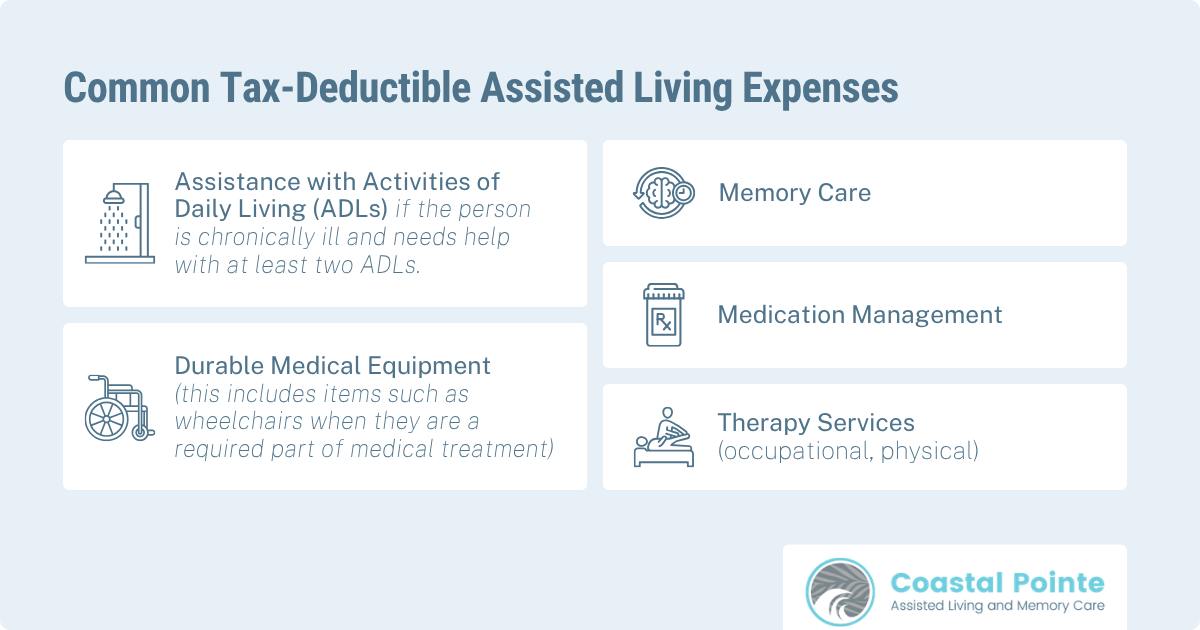
Can Caregivers Claim Assisted Living Tax Deductions?
By caregiver, we mean adult family members or even adult children who are paying for the resident’s care.
Again, this is one of those tax areas that can be quite complicated and has strict parameters. The following is just some general information. We encourage you to refer to the IRS website or speak with a tax professional for details.
If the caregiver itemizes their taxes, and if the parent is claimed as a dependent, then the caregiver can deduct the medical expenses they have paid for.
But remember, in order to do so, the parent or resident must qualify as a dependent.
If you’re attempting to claim these deductions, be sure you have extensive documentation that proves you’re paying for expenses that qualify.
What Are Some Common Mistakes (and How Can I Avoid Them)?
When you’re dealing with the extensive details of tax law, it’s critical to thoroughly document everything, examine the tax laws completely and speak with your tax advisor.
That being said, here are some common mistakes you should avoid if you decide to try to deduct assisted living expenses:
- Failing to have documentation that demonstrates the assisted living stay is for medical care
- Overlooking the need to break down medical vs. nonmedical expenses
- Assuming that you can deduct room and board (you can’t deduct this unless it is primarily medical)
- Forgetting to look at the 7.5% threshold (we mentioned this earlier)
- Keeping poor receipts: Remember that you must document everything
- Failing to consult a tax advisor before filing
Coastal Pointe Is an Assisted Living Community in Shallotte That Feels Like Home
Being in assisted living doesn’t guarantee a tax deduction, but in certain cases, you may be able to get some tax relief if you meet the detailed IRS criteria.
Once again, we’d like to emphasize the importance of working with your tax advisor or accountant to get the most accurate details. You can also visit the website for the Internal Revenue Service to get additional information.
Our assisted living community is staffed by compassionate professionals who are always ready to give a helping hand whenever needed. Our ideal location–minutes from the beach and major medical facilities–means you have access to what matters most, enabling you to thrive in an environment that feels like home. We invite you to experience the friendly atmosphere of Coastal Pointe for yourself by scheduling a tour.
Key Takeaways
- Coastal Pointe offers flat-fee assisted living pricing, ensuring residents never face hidden costs or billing surprises.
- Some assisted living expenses may qualify as tax-deductible medical expenses, depending on IRS criteria and physician documentation.
- Assisted living costs are only deductible when the primary reason for residency is medical care.
- Eligible deductions may include medication management, therapies, and help with activities of daily living (ADLs) when prescribed by a doctor.
- Only medical-related expenses qualify; room and board are not deductible unless primarily for medical care.
- Deductions apply only to the portion of medical expenses that exceed 7.5% of adjusted gross income (AGI).
- State tax laws can vary, so residents should always verify their eligibility with a qualified tax professional.
- Caregivers (such as adult children) may be able to claim deductions if they itemize and the assisted living resident qualifies as a dependent.
- Common mistakes include failing to separate medical from nonmedical costs, assuming all expenses qualify, and neglecting proper documentation.
- Coastal Pointe emphasizes transparency, comfort, and compassionate care—providing a home-like atmosphere with easy access to medical facilities and the beach.
Residents and families are encouraged to speak with their tax specialist and schedule a tour to experience Coastal Pointe’s welcoming community.
Sources:
A Place for Mom, “Is Assisted Living Tax Deductible?” https://www.aplaceformom.com/caregiver-resources/articles/assisted-living-tax-deductible
Assisted Living.org, “Are Your Parents’ Assisted Living Expenses Tax-Deductible?” https://www.assistedliving.org/are-parents-assisted-living-expenses-tax-deductible/
Internal Revenue Service, “Medical, Nursing Home and Special Care Expenses,” “https://www.irs.gov/faqs/itemized-deductions-standard-deduction/medical-nursing-home-special-care-expenses/medical-nursing-home-special-care-expenses